

Voices of Work
3 min read
Career Transitions During Digital Restructuring in Schools
Synopsis
HR and school leaders learn how to turn digital restructuring from a source of fear into a clearer path for staff, using transparent communication, reskilling, and thoughtful redeployment to protect stability and retention.
Key Insight
When schools modernize their systems, the technology often works. The human adjustment is more complex.
Career transitions during digital restructuring involve more than just software. They also involve identity, stability, and clarity. Effectively navigating these transitions requires employers to help staff understand how their roles will evolve as the systems around them change.
Mark Friend, Director of Classroom365, has over two decades of experience guiding UK schools through infrastructure upgrades and cloud migrations. In a recent exchange, Mark shared several observations from his advisory work supporting schools through these transitions.
He claims the issue is not a technical breakdown but rather uncertainty about where people will fit into the new structure.
When Change Feels Personal
Digital restructuring often introduces automation, new platforms, or cloud-based systems. For long-serving educators and administrators, this can feel more like displacement than modernization.
Mark explained:
“I’ve seen that fear derail projects.”
When staff are unsure about how their experience translates into the new structure, resistance is understandable. While the system itself may be sound, a lack of clarity around evolving roles can create cracks in its foundation.
In one large secondary school transitioning to cloud management, the staff reacted defensively. Their concern was not the platform itself, but rather the perception that their existing skills were becoming irrelevant.
For HR leaders, this is often a pivotal moment. If the emotional impact is not acknowledged early on, restructuring becomes increasingly challenging to manage.
Reskilling Is About Confidence, Not Clicks
Career transitions during digital restructuring can progress more smoothly when employers assess individual strengths before starting skill training.
Mark shared the story of a veteran receptionist who was redeployed into a data compliance lead role during a systems shift. Instead of hiring externally, leadership admired her deep institutional knowledge and realigned it with the new responsibilities that emerged.
“The greatest values are gained by finding the fit between a person’s strengths and a modified architecture.”
This approach reframes the concept of redeployment, emphasizing that it is not simply about employees learning to use new software but about recognizing which human capabilities become more critical as specific tasks become automated.
Mark emphasized:
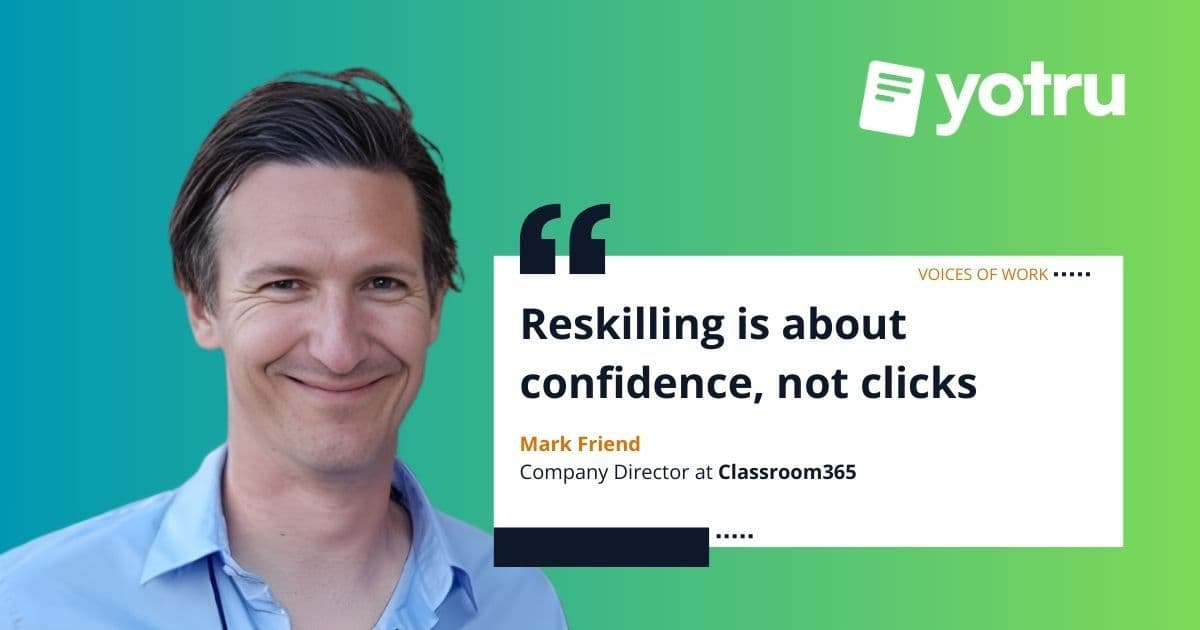
“That transition proved that reskilling is about confidence and not just learning where to click on a screen.”
When staff understand how their experience applies to their new roles, training can feel like a progression rather than a correction.
Across broader workforce systems, similar patterns emerge. Clear communication about future roles facilitates a more constructive adaptation process.
Communication Before Configuration
A common mistake Mark observes is a delay in communication. Leadership often introduces new hardware or systems without preparing staff for how their daily work will change.
“I’ve learned that the biggest mistake in school restructures is keeping staff in the dark until the new hardware is launched.”
Transparency helps reduce speculation, and using plain language can alleviate anxiety. Mark emphasizes the importance of explaining the “why” behind changes rather than focusing solely on technical specifications.
He also advocates for phased automation: a gradual implementation that allows staff to adjust and ask questions rather than facing abrupt shifts all at once.
While digital restructuring can move quickly, human adaptation usually takes longer.
From Task Elimination to Value Reallocation
Mark’s team evaluates which manual tasks will be automated and where human involvement becomes more valuable, particularly in oversight roles and student-facing responsibilities.
He put it simply:
“My team focuses on the people, as the hardware is useless without a willing operator.”
Automation does not eliminate the need for judgment or institutional knowledge; it merely shifts where these capabilities are applied.
Career transitions during digital restructuring are more stable when staff members can see a defined role for themselves within the new structure. When this clarity is missing, uncertainty grows. Conversely, when team members have a clear understanding of their place, they tend to adjust more smoothly.
About Mark Friend
Mark Friend is the Director of Classroom365 Limited, an IT services provider that supports schools across the UK. With nearly 30 years of experience in technology and more than 20 years focused specifically on the education sector, he has led infrastructure upgrades, cloud migrations, and ICT strategy initiatives for both primary and secondary schools. His work emphasizes aligning technical modernization with long-term institutional stability.
Pro Tip
This article is part of Yotru's Voices of Work series, highlighting leaders who are redefining how people learn, lead, and get hired. To get featured, please contact us.
About the Author

Hannah Verkler
Media Relations Lead
Hannah Verkler
Media Relations Lead
Hannah leads media relations and external communications at Yotru, helping share the company’s work with journalists, partners, and the workforce community.
Frequently Asked Questions
Career transitions during digital restructuring refer to the process of redefining roles when technology changes how work is performed. This may involve redeployment, reskilling, or shifting responsibilities toward oversight, compliance, or higher-value human functions rather than manual administrative tasks.
About This Article
How HR and school leaders in the UK can manage career transitions during digital restructuring in schools—reducing fear, redeploying staff strengths, and supporting reskilling without triggering unnecessary turnover.
Research Methodology
This feature is based on a direct written exchange with Mark Friend and publicly available professional information supplied by the contributor. All examples and quotes are drawn from provided material without fabrication or extrapolated statistics.
Editorial Standards
Yotru’s Voices of Work series prioritizes practitioner insight grounded in real-world experience. Quotes are used verbatim from the contributor. Interpretations remain neutral and focused on workforce and institutional stability.
Disclaimer
This article reflects the professional observations of Mark Friend based on his experience in UK schools. It does not constitute legal, HR, or organizational advice and should be interpreted within the context of education sector digital restructuring.
Related Readings
Voices of Work
- Why qualified candidates fail resume screening — A Leadership and hiring perspective
- What Employers Really Mean by Job‑Ready — Employer ROI, hidden skills, and motivational fit in job readiness
Fallon Chase on Fractional HR and the Future of People Operations — Fractional leadership and scaling people ops - Nicole Fougere on Trust, Tools, and the Future of Hiring — Building trust into hiring systems
- Robert Hourie on AI, Instinct, and the Future of Recruitment — Balancing AI with recruiter judgment
- Gloria Espina on Suitability, Systems, and Human-First Hiring — Suitability over credentials
Platform and Solutions
- Yotru for Workforce Development — Tools for workforce organizations
- Yotru for Employers — Hiring and talent solutions
- Yotru for Outplacement — Supporting workforce transitions
- Yotru for Educators — Career services for education providers
People Strategy and Hiring
- Why Yotru Is Built for Real Hiring, Not Just Resume Writing — Systems built for real hiring outcomes
- Why HR Departments Are Using Yotru to Support Laid-Off Workers — Humane layoff support tools
- How Yotru Helps Regions Identify Upskilling and Retraining Opportunities — Regional workforce strategy
- What Is a Risk-Free Hiring Pilot Program — Testing hiring systems safely
Job Market and Interview Insights
- Why It Feels So Hard to Get a Job Right Now — Market pressures and constraints
- Why Interviews Feel Harder Than the Actual Job — Where process and work diverge
- Green Flags in Interviews — Signs of healthy hiring cultures
- What Hiring Managers Really Notice in the First 5 Minutes — Signals that matter early
References
- Department for Education. (2022). Digital and technology standards for schools and colleges. UK Government. https://www.gov.uk/guidance/digital-and-technology-standards-for-schools-and-colleges
- Education & Training Foundation. (2020). Enhancing digital teaching and learning: The EdTech demonstrator schools and colleges programme. Education & Training Foundation. https://www.et-foundation.co.uk
- Jisc. (2022). Technology and data insights for UK education: Digital transformation in schools and colleges. Jisc. https://www.jisc.ac.uk
- National Foundation for Educational Research. (2021). The digital divide: Technology, disadvantage and education in England. NFER. https://www.nfer.ac.uk
- Trades Union Congress. (2021). Technology managing people: The worker experience in the UK. TUC. https://www.tuc.org.uk
Maintained by: Workforce Practice Group at Yotru
Review cycle: Reviewed periodically to reflect evolving hiring trends
Last updated: February 19, 2026
Questions or Need Support?
If you are working on employability programs, hiring strategy, career education, or workforce outcomes and want practical guidance, you are in the right place.
Yotru supports individuals and organizations navigating real hiring systems. That includes resumes and ATS screening, career readiness, program design, evidence collection, and alignment with employer expectations. We work across education, training, public sector, and industry to turn guidance into outcomes that actually hold up in practice.