
Voices of Work
3 min read
Amanda Main on Gen Z's Career Pivot
Synopsis
A work psychologist reveals why Gen Z is pivoting to skilled trades and technical careers, redefining success through stability, real skills, and adaptable paths over titles.
At Yotru, we share stories from people shaping how work feels and how it evolves. Each Voices of Work feature highlights a leader influencing the way people learn, grow, and get hired.
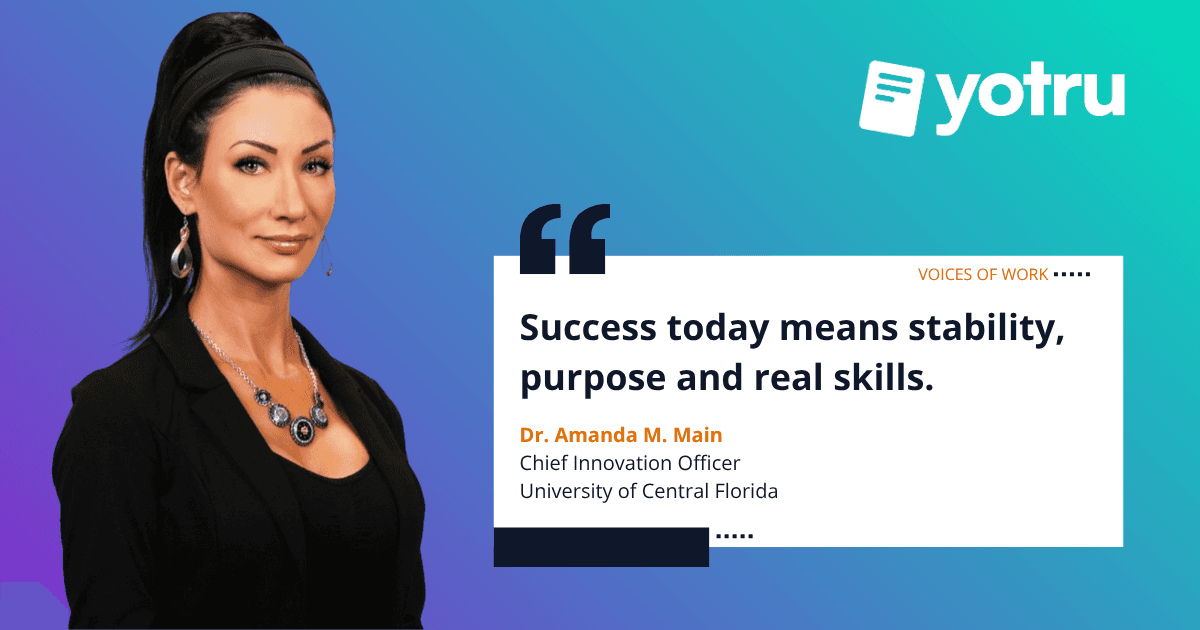
This time, we spoke with Dr. Amanda M. Main, Chief Innovation Officer at the University of Central Florida College of Business, an award-winning psychologist and educator known for her research on leadership, team dynamics, and the psychology of work. She has been studying a quiet but powerful shift among Gen Z that is reshaping what career success really means.
The New Blueprint: Why Gen Z Is Changing Course
Amanda has spent years preparing future business leaders, but she says the next generation is no longer following the same career script.
More than 40% of Gen Z are entering trades or technical fields, including many who already hold university degrees. A growing number say they would trade a desk job for something that offers more stability, fair pay, and freedom.
“It’s not rebellion,” she said. “It’s realism.”
That shift matches what we see at Yotru. Young professionals are building resumes that highlight real skills, certifications, and projects that show what they can actually do. Proof is becoming more valuable than polish, and it is changing how hiring decisions are made.
When AI Moves the Goalposts
Amanda is direct about the reality of automation. Entry-level white-collar jobs, once considered safe, are being replaced at a fast pace. Studies predict that as many as half could disappear within the next five years. For her, the lesson is clear: students need adaptable, cross-functional skills that will stay useful as technology continues to evolve.
She calls this “career insurance through learning.” The workers who thrive will be the ones who stay curious, keep learning, and combine technical ability with human qualities like empathy, creativity, and judgment.
The Trade-Up: Stability Meets Strategy
While technology changes office work, the trades are facing a very different challenge. Industries like construction are short hundreds of thousands of skilled workers. For Gen Z, that shortage represents opportunity, not decline.
Trade programs cost less than university, often allow students to earn while they learn, and prepare them for work that is hard to automate. Many young people are blending technical training with business or technology skills to create hybrid careers, such as a carpenter who manages projects or a welder who understands automation systems.
Redefining What Success Looks Like
Amanda believes this shift is as much cultural as it is economic. “Gen Z isn’t giving up on ambition,” she said. “They are redefining it.” Success is starting to mean stability, autonomy, and visible results rather than titles or office walls.
She encourages educators and employers to adapt by combining classroom learning with practical experience, expanding apprenticeships, and treating skilled trades as respected, future-proof career paths. The old ladder no longer fits today’s reality. What is taking its place is a network of flexible pathways that reward learning and adaptability.
About Dr. Amanda M. Main
Dr. Main is Chief Innovation Officer and Assurance of Learning Coordinator at the University of Central Florida College of Business. An industrial-organizational psychologist and executive coach, she has advised organizations from NASA to early-stage ventures and has been featured for her work on leadership, innovation, and workplace culture.
Pro Tip
This article is part of Yotru's Voices of Work series, highlighting leaders who are redefining how people learn, lead, and get hired. To get featured, please contact us.
ATS-Optimized resumes That Meet Employer Standards
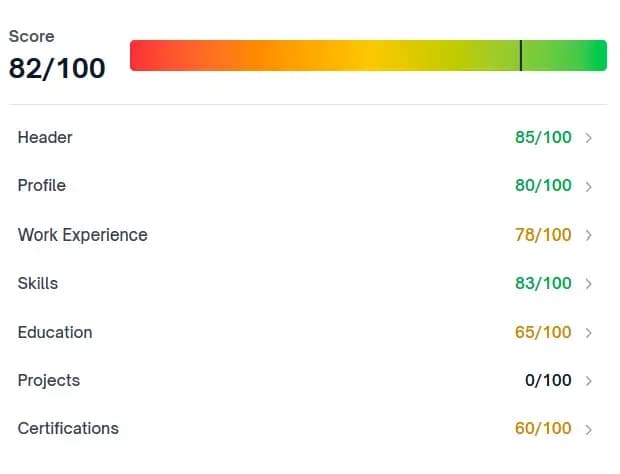
Our AI-powered scoring system helps organizations assess and standardize resume quality at scale. ATS-compliant templates support consistent formatting, keyword alignment, and interview readiness across cohorts.
About the Author

Team Yotru
Employability Systems
Team Yotru
Employability Systems
We build practical career tools for training providers and workforce programs, combining labor market insights with real employment outcomes. Follow us on LinkedIn.
Audience Context
For educators, employers, and Gen Z job seekers. Learn why young professionals are redefining career success through skilled trades, stability, and adaptable skills from a work psychologist studying generational workforce shifts.
Disclaimer
Views shared reflect personal experience only. Not official advice. Hiring practices vary by company and region. Use for general guidance, not as professional or legal advice.
Recommended Reading
Outcomes and CV signals
- Traits All Great Resumes Possess — Core traits hiring managers scan for
- What Methods Show Impact — Structure bullets around outcomes
- What Hiring Managers Notice First — Signals that stand out in seconds
- What Hundreds of Resumes Taught — Lessons from real CV reviews
- Resume Length: One or Two Pages — Scope and focus for 2026 CVs
Skills-first, not CV-first
- Skills in Resume for Freshers — Highlight skills, not just titles
- Why It Feels Hard to Get a Job — Market shift toward skills-first
- Why Interviews Feel Harder — Process vs real capability
- Job Search Strategies That Work — Strategies aligned with new filters
- How to Target Job Keywords — Matching skills to JD language
Character, values, and fit
- Emily Demirdonder on Character — Character over credentials
- Nicole Fougere on Trust — Trust, tools, and proof
- Gloria Espina on Suitability — Suitability beyond CV labels
- Green Flags in Interviews — Behavioural signals of fit
- What Really Matters in Interviews — How managers test for fit
Voices of Work and hiring trends
- Alex Kovalenko on Tech Hiring — Tech recruiter’s view on signals
- Amanda Main on Gen Z Pivot — Changing paths and proof
- Robert Hourie on AI & Instinct — AI plus recruiter judgment
- Em Richards on Storytelling — Story as evidence of value
- Danielle Ayodele on Safe Learning — Coaching toward measurable impact
Resources
- Why Hiring for Character Matters — Case for character-first CV review
- Why Hire Character Over Credentials — Outcomes of character-first hiring
- Values-Based Recruitment — Hiring on values and behaviours
- Skills-Based Hiring vs the CV — Moving from CV-first to skills-first
- Hiring Trends Report 2026 — Shift away from CV-only screening
References
1. Parker, K., & Igielnik, R. (2020). On the Cusp of Adulthood and Facing an Uncertain Future: What We Know About Gen Z So Far. Pew Research Center. https://www.pewresearch.org/social-trends/2020/05/14/on-the-cusp-of-adulthood-and-facing-an-uncertain-future-what-we-know-about-gen-z-so-far/
Comprehensive research on Gen Z career attitudes, economic realities, and workforce expectations.
2. U.S. Bureau of Labor Statistics. (2024). Employment Projections: 2023-2033. https://www.bls.gov/emp/
Government data on occupational outlook, including construction and skilled trades workforce shortages and growth projections.
3. McKinsey Global Institute. (2023). Generative AI and the Future of Work in America. https://www.mckinsey.com/mgi/our-research/generative-ai-and-the-future-of-work-in-america
Analysis of automation impact on white-collar and entry-level positions, including displacement forecasts through 2030.
4. National Center for Education Statistics. (2024). Career and Technical Education (CTE) Statistics. https://nces.ed.gov/surveys/ctes/
Data on enrollment trends in technical and vocational education programs, including Gen Z participation rates.
Maintained by: Workforce Practice Group at Yotru
Review cycle: Regularly reviewed to reflect real-world practice
Last updated: December 30, 2025
Continue Reading
More insights from our research team

AI in Career Services: Practical Use Cases That Don't Replace Advisors
AI in career services isn't about replacing advisors. It's about handling baseline tasks so career professionals can focus on coaching and relationship building.
7 min read
Why Young People Struggle to Get Hired (and What Employers Really Look For)
Students aren’t failing the job market because they lack skills, but because they struggle to translate them. Sandra Davis explains how language, behaviour, and structured thinking separate candidates who get noticed from those who don’t, and what employers actually look for beyond grades.
5 min read

Why Tech Interviews Feel Harder Than the Actual Job
Tech interviews often feel harder than the job itself because they test speed, abstraction, and edge cases instead of real work. Here’s why the gap exists and how to handle it.
6 min read

Is AI Pushing Gen Z Toward Blue-Collar Careers? What the Data Actually Shows
AI is changing how Gen Z thinks about work, but it’s not a simple shift to blue-collar jobs. Interest in trades is rising due to automation fears, but the reality is more nuanced.
6 min read