

Employability
3 min read
You Got the Interview. Now Here’s How to Actually Nail It
Synopsis
Getting the interview is only step one. What matters now is how you show relevance, confidence, and clarity under pressure. Here’s how to prepare, structure your answers, and leave a strong impression.
You worked hard to get a job interview. You updated your resume, applied to countless postings, and finally someone reached out with a time to meet. This is your chance. So lets make sure you walk in confident and ready.
Most people show up hoping for the best. The people who actually get hired are the ones who prepare. And the truth is, a little bit of homework goes a long way.
Here is a simple way to get yourself ready so you can stay calm, answer clearly, and impress the hiring manager.
Start With the Questions About You and Your Role
These are the warm-up questions and they seem easy, but they matter more than people think. They set the tone for the entire conversation.
You will probably hear questions like:
- Tell me about yourself.
- Walk me through your background.
- Why did you choose this field.
- What do you do in your current role.
Your job here is to give a short, honest summary of who you are, what you have done, and where you want to go next.
Aim for a clear one to two minute story that naturally connects your past experience to the job you are interviewing for.
Go Deeper Into Your Experience and Your Resume
This is the part most applicants overlook. This is also the part that usually decides who gets the offer.
Take your resume and go through it line by line. If something is written on it, you should be able to talk about it confidently.
For every job, project and skill you listed, ask yourself:
- What exactly did I do
- What tools or skills did I use
- What problems did I solve
- What results did I create
- Do I have a short story or example ready
This should be a simple 30 second example that shows what you did and why it mattered.
When an interviewer says, "Tell me more about your experience with this,"
you want to be ready immediately. No guessing, no scrambling, no long pauses.
This is what separates a prepared candidate from someone who is trying to wing it.
Prepare for Questions About the Specific Role
Now shift your focus from your world to their world.
Look closely at the job posting. Think about the tools, the responsibilities, the problems they are trying to solve and the type of person they want on their team.
Ask yourself, "If I were the hiring manager, what would I want from someone in this role". Then prepare for questions like:
- How would you handle this responsibility
- Tell me about a time you did something similar
- What would you focus on in your first 90 days
- What experience do you have with the tools or systems we use
Your goal is to connect your experience to their needs. When you do that well, the hiring manager immediately starts picturing you in the role.
End Strong With Good Questions You Can Ask Them
At the end of the interview they will ask, "Do you have any questions for us"
Never say no.
This is your moment to show curiosity and confidence. It also helps you understand if the job is right for you.
Good questions to ask include:
About the Role
- What are the top priorities in the first few months
- What does success look like
About the Team
- What is the team culture like
- What is your leadership style
About the Company
- What are the main goals this year
- How does this role support those goals
About Growth
- What opportunities are available for learning and development
Ask the questions that genuinely matter to you. This leaves a strong final impression.
How Yotru Helps You Get the Job
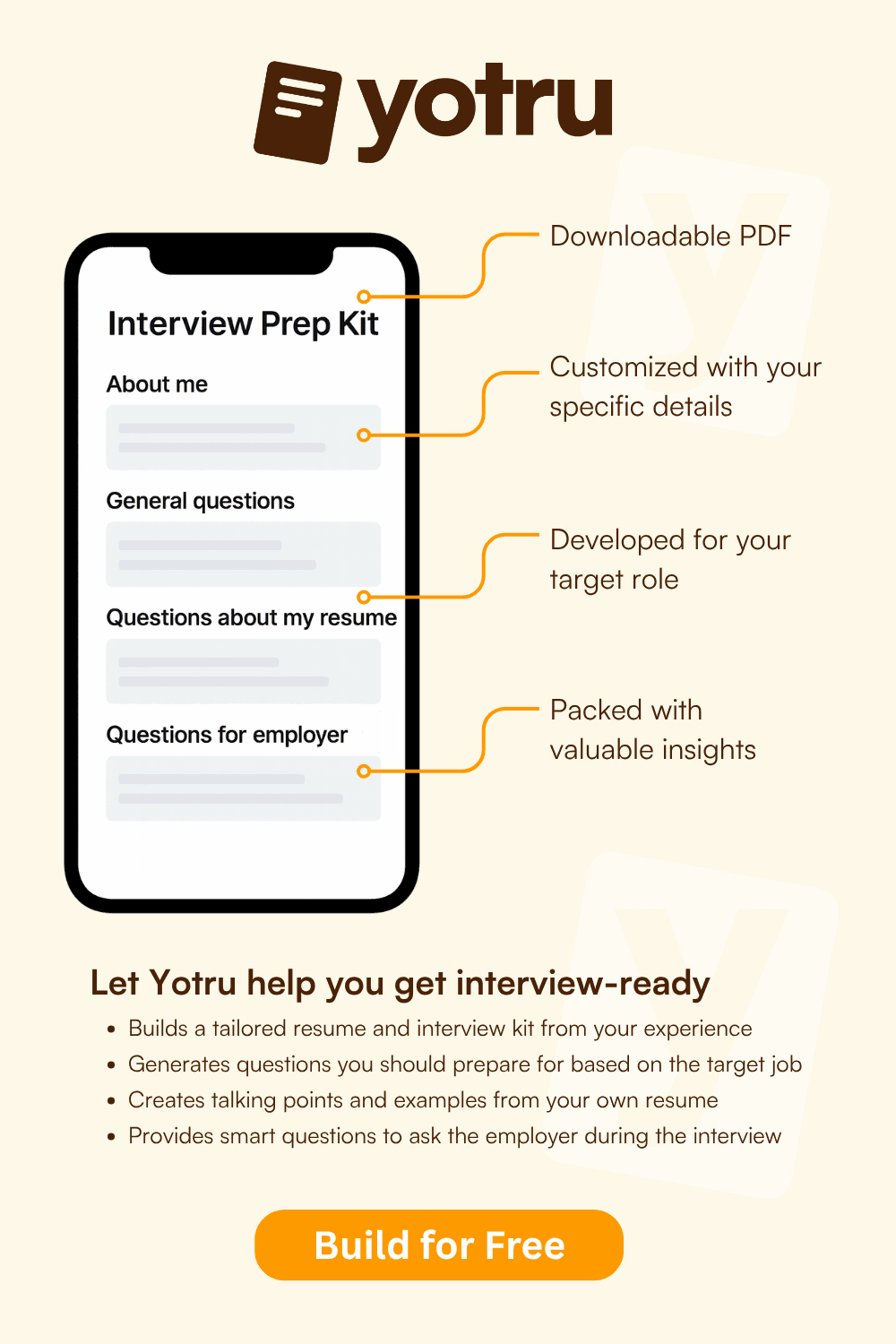
At Yotru, we created an Interview Prepare Kit that builds all of this automatically using your resume and your target job.
It does all the hard work for you. It creates a tailored and optimized resume you can use in your application.
It also builds a full interview preparation kit, just like the one above, based on your experience and the job you want.
It is not just about getting an interview. Our job is to help you get the job you actually want.
So build your resume, cover letter and interview prep kit on Yotru.
About the Author

Maria Santos
Career Researcher
Maria Santos
Career Researcher
Maria is a Career Researcher at Yotru, studying hiring trends, resumes, and job pathways to strengthen the platform’s career guidance and insights.
Frequently Asked Questions
Research the company, understand the role, and prepare answers using real examples. Practicing responses out loud helps improve clarity and confidence.
Continue Reading
More insights from our research team

Best Resume Builder for Laid-Off Employees
Getting laid off puts you under pressure to update your resume quickly. This guide covers what to look for in a resume builder when you've been let go, and how to get back to interviews faster.
4 min read

Welder Salary in Canada 2026: What You Can Actually Earn
Welder pay in Canada varies widely by province, certification, and industry. This guide breaks down what entry-level, certified, and industrial welders actually earn — and what separates a $60K welder from a $120K one.
5 min read

Green Flags in Interviews: The Subtle Clues That Matter
For job seekers preparing for interviews: learn the subtle green flags that signal you’re on the right track, from conversation flow to interviewer behavior and hidden cues that often predict success.
6 min read

How to Write a Phlebotomist Resume That Gets You Hired
Writing a phlebotomist resume requires more than listing duties. Learn which clinical skills, certifications, and keywords actually matter to hiring managers in labs and hospitals.
14 min read